This report evaluates the performance and commodity security of Uganda’s health supply chain managed under the Ministry of Health from January to December 2025. Using aggregated operational data, it assesses logistics metrics across public health facilities, national drug authorities, and private-not-for-profit sectors. Key findings show that strategic partnerships among government bodies, international donors, and civil society enabled coordinated distribution across national and district networks. Ultimately, multi-stakeholder coordination remains essential to maintaining supply chain resilience and improving health commodity access nationwide.

The report assesses NPECAF performance for Q3 FY 2025/26, focusing on pharmaceutical accountability, essential medicines availability, governance, and supply chain performance. It highlights key achievements, challenges, and actions needed to strengthen medicines management and health service delivery in Uganda.

The report is produced under the Department of Pharmaceuticals and Natural Medicines (DPNM) and focuses on pharmaceutical stewardship, medicines accountability, essential health commodities, pharmacovigilance, antimicrobial stewardship and health supply-chain performance.
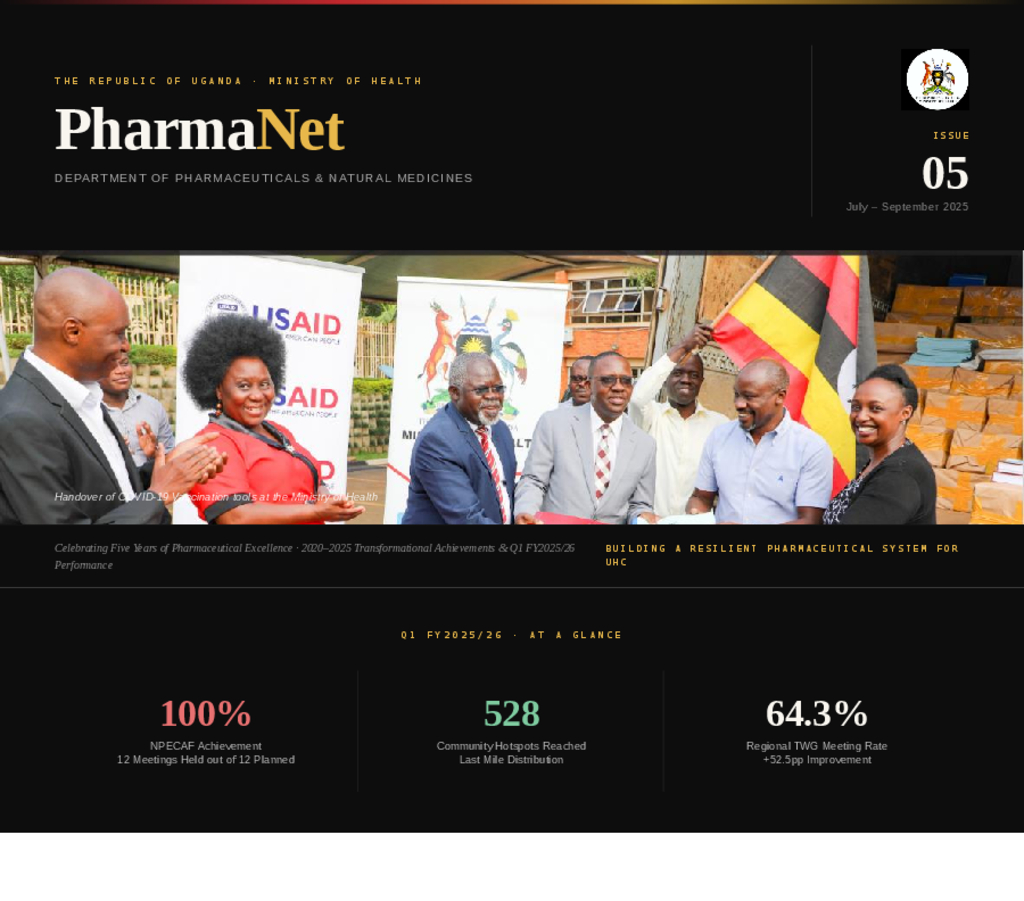
The PharmaNet Newsletter, Issue 05 (July–September 2025) highlights the Ministry of Health's key achievements in strengthening Uganda's pharmaceutical system, including improvements in supply chain management, digitalisation, governance, local manufacturing, and medicines safety, while outlining priorities for enhancing access to essential medicines and universal health coverage.
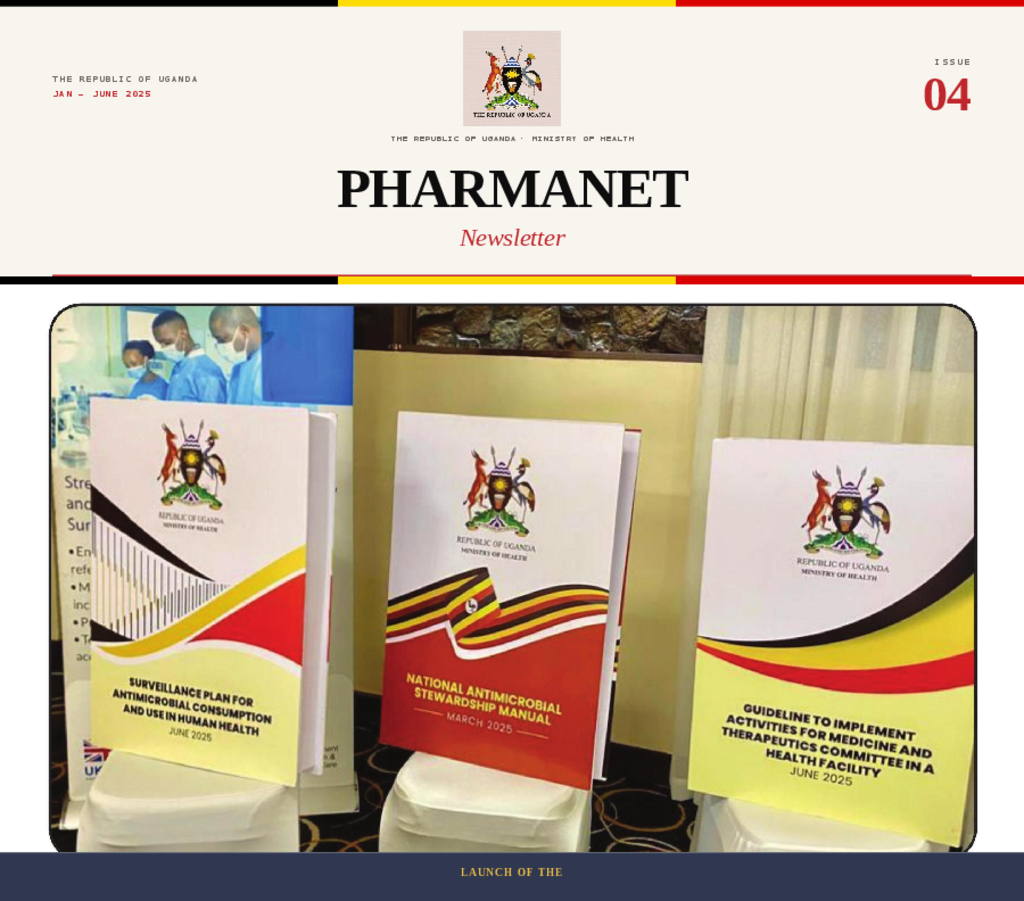
This newsletter highlights the Ministry of Health's pharmaceutical achievements and challenges from January–June 2025, covering health supply chain management, pharmacovigilance, antimicrobial stewardship, Medicines and Therapeutics Committees, capacity building, and digital innovations to strengthen pharmaceutical service delivery in Uganda.
This addendum to the Essential Medicines and Health Supplies List of Uganda (EMHSLU) 2023 introduces six essential maternal and newborn health commodities to improve service delivery, strengthen clinical care, and reduce maternal and neonatal mortality. It supports standardized procurement and advances Uganda’s commitment to better health outcomes.
Abstract
The Last Mile Assurance Guidelines for Essential Medicines and Health Supplies (2024) provide a comprehensive framework to strengthen accountability, transparency, and availability of essential medicines and health supplies at the point of service delivery. The guidelines aim to address persistent challenges related to stock-outs, pilferage, data inaccuracies, and inefficiencies in last-mile distribution across public health facilities.
The document outlines standardized procedures for planning, receipt, storage, distribution, use, and reporting of medicines and health supplies, with an emphasis on real-time data use, routine verification, and community-level accountability. It promotes the integration of digital health information systems, including logistics management and reporting tools, to enhance visibility and traceability of commodities from central warehouses to end users.
Additionally, the guidelines define the roles and responsibilities of key stakeholders at national, district, health facility, and community levels, while reinforcing supportive supervision, performance monitoring, and corrective action mechanisms. By institutionalizing last mile assurance practices, the guidelines seek to improve service delivery outcomes, reduce wastage, and ensure continuous availability of quality-assured medicines and health supplies to the population.
The framework describes step-by-step process of formulating, implementing, monitoring, reviewing and reforming the health supply chain-related policies, regulations and guidelines. Specifically, the framework (i) provides the principles which guide the formulation and review of health supply chain policies, guidelines, regulations and reforms; (ii) establishes standardized procedures to ensure consistent formulation, approval, monitoring, and review of health supply chain policies, guidelines, regulation and reforms; and (iii) provides a comprehensive, single point of reference for information relating to health supply chain policy formulation, approval, implementation, monitoring, evaluation, review and analysis.

Antimicrobial resistance is a natural process that happens over time through genetic changes in pathogens. This National Antimicrobial Stewardship Manual describes the Antimicrobial stewardship governance and leadership, approaches to surveillance of Antimicrobial resistance and diagnostic stewardship, guidance on generating information on antimicrobial consumption and use at national and subnational levels, application of infection prevention and control, supply chain management for AMS, education, training, advocacy, implementation of AMS at facility level and monitoring and evaluation.
The Annual Pharmaceutical Services Performance Report 2023/24 reviews the progress made towards achieving the targets set in the National Pharmaceutical Services Strategic Plan (NPSSP) 2020/21 - 2024/25. Progress is assessed by examining the trends in the 32 selected indicators over time and comparing them to set targets. The report covers eleven (11) priority areas of the National Pharmaceutical Sector Strategic Plan (NPSSP) which are aligned with the objectives in the National Medicines Policy 2015.
The National Medical Countermeasures Plan for Public Health Emergencies as a core strategy for achieving the Global Health Security Agenda and enabling Uganda to be more prepared to respond to PHEs. Stronger emphasis has been put on the principle of the national stockpile and prepositioning to ensure continuous availability and accessibility to Medical Countermeasures, support to deploy personnel and the transportation services for samples and cases.
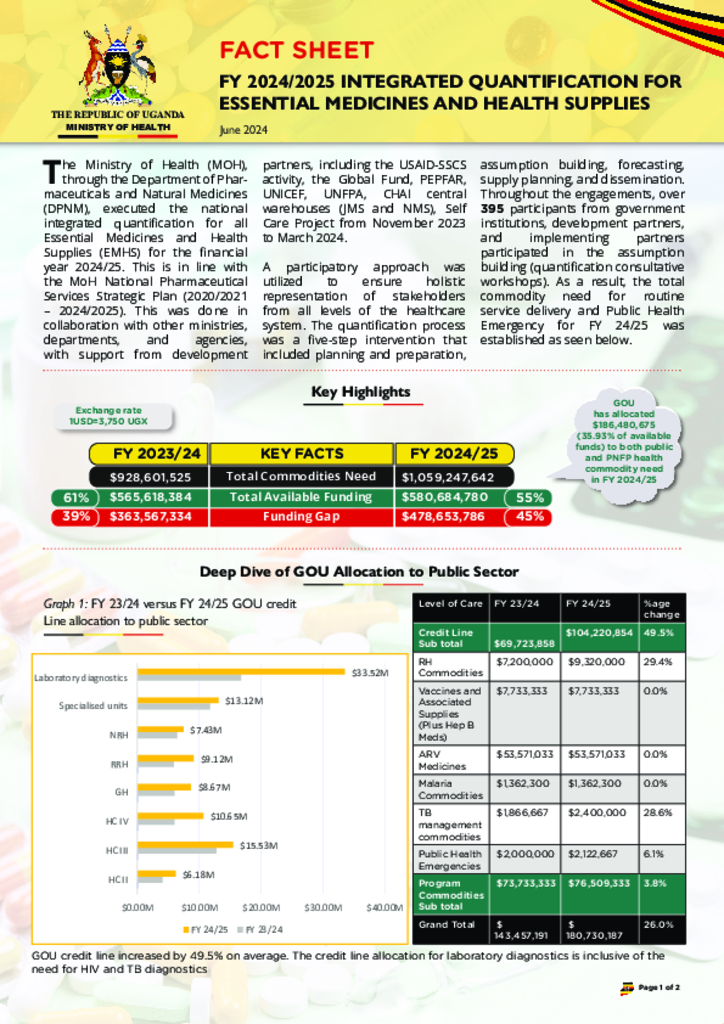
The Ministry of Health (MOH), through the Department of Pharmaceuticals and Natural Medicines (DPNM), executed the national integrated quantification for all Essential Medicines and Health Supplies (EMHS) for the financial year 2024/25. As a result, the total commodity need for routine service delivery and Public Health Emergency for FY 24/25 was established as documented in the factsheet.